
6 min read

Received a COVID EIDL Collection Letter? What to Verify First

Received a COVID EIDL Collection Letter? What to Verify First

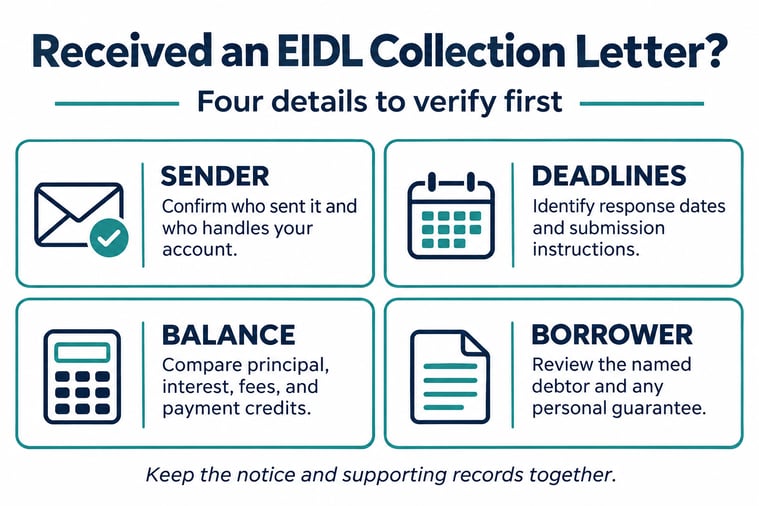
Recent Forbes reporting has highlighted COVID EIDL borrowers facing collection demands and questions about prior notices, payment histories, and personal obligations. 1 If an EIDL collection letter has arrived at your home or business, those concerns may feel familiar. Your next step begins with the details of your own loan: who sent the notice, what it requests, when a response is due, and how the demand compares with your records.

Is This EIDL Collection Letter Legitimate?

A letter from an unfamiliar collection company may be legitimate. The U.S. Department of the Treasury uses private collection agencies to collect delinquent federal debts, including COVID EIDL loans referred for collection. However, a company name or government logo alone does not establish that a particular letter is authentic.

Before sending money or sharing sensitive information:

  • Verify the company independently. Compare its name and contact information with Treasury’s published list of private collection agencies. 2
  • Use an independently verified contact number. Contact the company through the number on Treasury’s website to confirm that it sent the letter and is handling your account.
  • Match the notice to your records. Compare the borrower name, business name, and any SBA loan number shown with your loan documents. Identify discrepancies for follow-up.

A company’s appearance on Treasury’s list does not prove that your specific loan has been assigned to it. Likewise, confirming that a letter is authentic does not establish that every amount or statement in it is correct.

Best Practice: Keep the letter and envelope, note when you received them, and verify the sender promptly while keeping track of any stated response deadline.

Received EIDL Collection Letter

 Who Should You Contact About Your EIDL Collection Letter? 

Once you have verified the sender, determine who currently handles your loan. That affects where to direct account questions and discuss repayment.

Sender What it may mean for your next step
SBA The notice may concern missed payments, default, or an upcoming referral. Confirm whether SBA still services the loan or whether a transfer has since occurred.
Treasury’s Bureau of the Fiscal Service Identify the program named in the notice. Cross-Servicing handles collection of referred debts, while the Treasury Offset Program concerns withholding eligible government payments to collect debt.
A private collection agency If your account has been assigned to the agency, Treasury directs borrowers to that agency for account-specific questions.


SBA states that COVID EIDL loans transferred to Treasury’s Cross-Servicing program are no longer serviced by SBA. An older SBA letter or information still visible in your loan portal should therefore be considered alongside the latest correspondence.

Key Consideration: A Treasury offset notice does not, by itself, establish that Cross-Servicing or a private collection agency now handles your account. Identify the specific program and designated contact before directing your response.

 For more context on Treasury referral and collection tools, see what happens if you don’t pay back an EIDL loan. 

What Deadline Applies to This Notice?

There is no single response deadline for every EIDL collection letter. A payment demand, a notice of intent to offset federal payments, and a proposed wage garnishment can involve different requirements and response rights.

Read the entire notice, including any enclosures, and identify:

  • The action requested: Payment, submission of documents, or a response to a proposed collection action.
  • The applicable dates: Whether separate deadlines apply to payment, disputing the debt, or requesting a review or hearing.
  • The response instructions: Where and how to submit your response, and whether it must be received by a particular date.

Treasury’s published guidance lists different notice periods for different collection tools. Those periods should not be treated as interchangeable deadlines for responding to your particular letter. 3

If a date is unclear or has already passed, seek clarification promptly about any remaining response options. Keep copies of what you submit and proof of delivery.

Best Practice: Calendar each deadline separately. Do not assume that a phone call or request for information extends a deadline or pauses collection.

Why Is the Balance Higher Than Expected?

The amount demanded may include more than unpaid principal. Accrued interest and applicable penalties, administrative charges, or collection costs can increase the total. Treasury’s guidance explains that delinquent federal debts generally accrue additional charges under applicable law or the loan agreement. 4

Request an itemized breakdown and compare:

  • Unpaid principal: The remaining loan principal, including any loan increases you received.
  • Accrued interest: The amount charged and the period it covers.
  • Additional charges: Each penalty, administrative charge, or collection fee and the basis for its calculation.
  • Payments and credits: Whether payments and any amounts collected through offsets have been credited, accounting for processing dates.

Also check whether the letter demands the full outstanding balance rather than only the overdue installments. Those are different amounts and may explain part of the difference.

If the figures do not reconcile, identify the specific discrepancy and gather supporting records. Treasury provides a process for disputing an incorrect debt amount, but a higher balance alone does not establish an error or mean that added charges will be removed.

Best Practice: Compare figures as of the same date. An older portal balance and a newer collection demand may reflect different interest accruals, charges, or payment postings.

Is the Demand Against the Business, an Individual, or Both?

A letter addressed to you at home does not, by itself, establish that you personally owe the business’s debt. Review who is identified as the borrower or debtor and whether the demand names you as a guarantor.

The key documents to examine are:

  • The promissory note: Who borrowed the money, the business entity or you individually?
  • Any personal guarantee: Did you separately agree to repay the business’s obligation?
  • Loan increases and amendments: Did later changes add obligations or require additional signatures?

For COVID EIDL loans of $200,000 or less, federal law waived personal-guarantee requirements. However, that waiver does not eliminate an individual’s obligation when the individual is the borrower, as can occur with a sole proprietorship. 5 

Signing documents on behalf of an LLC or corporation is also different from signing a personal guarantee. The capacity in which you signed matters.

Key Consideration: Loan size, business ownership, and the mailing address are not enough to determine personal liability. If the demand appears inconsistent with your documents, or you are unsure what you signed, have an attorney review the obligation and the basis for pursuing you personally.

What If I Do Not Remember Receiving Earlier Notices?

If the collection letter is the first notice you recall receiving, document that concern and request the earlier correspondence. Not remembering a notice does not establish that it was never sent, but the communication history may warrant review.

Treasury’s guidance describes notice requirements before referral, including information about the debt and an opportunity to ask questions or arrange repayment. Whether those requirements were met in your account requires reviewing the actual records. 6

To understand what happened:

  • Search your available records: Review SBA portal correspondence, email folders, and mail retained by anyone who handled the business’s finances.
  • Check the contact history: Note changes to your mailing address, email address, or access to business accounts.
  • Request the notice record: Ask for copies of prior notices and information showing when and where they were sent.

Build a short timeline distinguishing what you received, what you found later, and what remains unavailable. If you believe required notice was missing or inadequate, an attorney can evaluate the applicable requirements and any potential remedy.

Key Consideration: A concern about prior notice does not automatically invalidate the debt or establish eligibility for fee removal or return to SBA.

What If I Cannot Afford the Requested Payment?

Start by determining whether you cannot pay the full demand immediately or whether even ongoing payments would be unaffordable. A temporary cash shortage and a lasting inability to repay require different discussions.

For loans still serviced by SBA, eligible borrowers experiencing temporary financial difficulty may qualify for a 50% payment reduction for six months. Interest continues to accrue during the reduced-payment period. Eligibility includes an actively operating business and specific loan-status requirements. This SBA payment-assistance program is not available for loans that have already been transferred to Treasury’s Cross-Servicing program.7

For debts in Treasury’s Cross-Servicing program, an installment agreement may be available based on a review of your finances. Treasury explains that borrowers may need to provide financial statements, expense documentation, and recent tax returns. Approval and terms depend on the account and applicable requirements. 8 

If the business has closed or cannot support repayment over time, seek an assessment of the broader situation before committing to a payment arrangement. Depending on your circumstances, that may involve EIDL resolution guidance, legal advice about liability or bankruptcy, and tax advice.

Best Practice Base any proposed payment on documented cash flow and essential expenses. Ask for written terms explaining how payments will be applied and whether other collection activity may continue.

 For a broader explanation of repayment and temporary assistance, read our SBA loan repayment guide. 

What Should I Gather Before Seeking Help?

You do not need a perfectly organized file to ask for help. Having the following items available can make the conversation more productive:

  • The collection letter and enclosures, including the envelope and any stated deadlines.
  • Your loan documents, including the promissory note, any personal guarantee, and loan increases or amendments.
  • Payment records, such as portal history, bank statements, and payment confirmations.
  • Earlier correspondence from SBA, Treasury, or a collection agency.
  • A brief business update: Whether the business is operating, struggling, or closed, and when significant changes occurred.
  • A current financial picture, including income, essential expenses, other debts, and available business assets.

Include a short list of unresolved questions—for example, an unexplained charge, a payment you cannot locate, or uncertainty about personal liability. Share sensitive documents through a secure channel agreed upon with the professional assisting you.

Best Practice: If a deadline is approaching, seek help with the records you have. Identify missing documents so they can be requested without delaying the initial conversation.

 Our guide to the risks of handling an EIDL situation yourself explains how loan obligations can intersect with business closure, asset sales, and other decisions. 

If you are unsure how to approach your COVID EIDL collection letter, schedule a free, no-obligation consultation with EiDLexit. We can discuss your circumstances and help you understand potential next steps.

Citations:

1.       Forbes - Why Small Business Owners Who Took Covid Loans Face Collection Now

2.       US Treasury Department - List of Private Collection Collection Agencies

3.       US Treasury Department - Due Process Guidelines

4,6,8  US Treasury Department - Cross Servicing FAQs

5.       US Code - Source: 15 U.S.C. § 9009

7.       SBA - Covid EIDL Guidance


Received a COVID EIDL Collection Letter? What to Verify First

Received a COVID EIDL Collection Letter? What to Verify First

Recent Forbes reporting has highlighted COVID EIDL borrowers facing collection demands and questions about prior notices, payment histories, and...
Read More
COVID EIDL FAQs: 3 Questions Business Owners Keep Asking

COVID EIDL FAQs: 3 Questions Business Owners Keep Asking

Can a COVID EIDL loan be forgiven? Is an Offer in Compromise available? Could bankruptcy eliminate the debt? These are three of the most common...

Read More
SBA EIDL Fraud Crackdown: What If You Simply Can't Repay Your Loan?

SBA EIDL Fraud Crackdown: What If You Simply Can't Repay Your Loan?

The SBA's recent crackdown on suspected pandemic loan fraud has brought renewed attention to COVID EIDL borrowers. But what about business owners who...

Read More